How many countries does the average frequent flyer visit?
The honest answer is that nobody publishes one. Airlines count miles, segments and revenue. Border agencies count arrivals, not lifetime unique countries. There is no registry that can tell you what “the average frequent flyer” has collected.
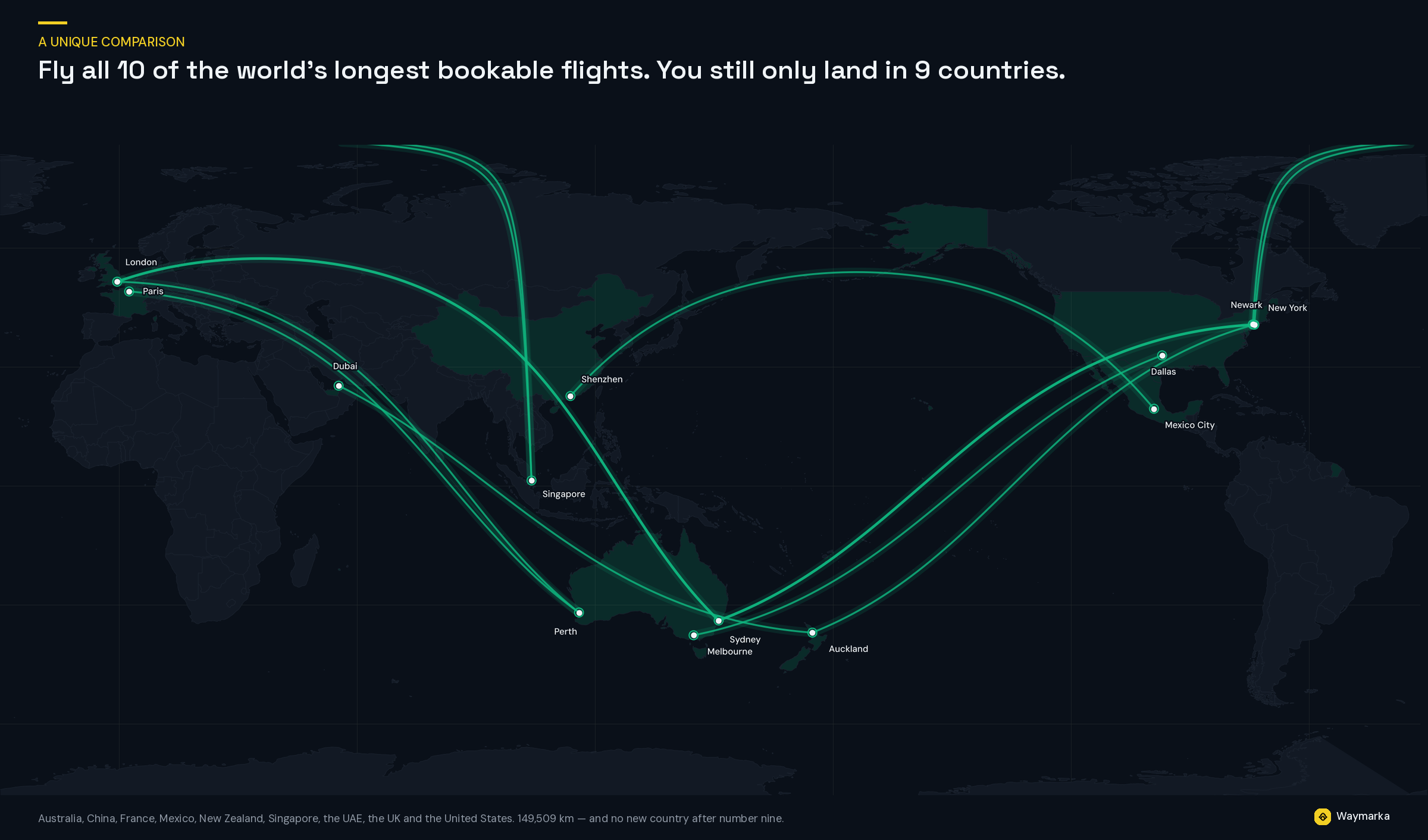
There is, however, a much more useful way to look at the question. The 10 longest flights you can book in 2027 — including Qantas’s forthcoming Sydney–London and Sydney–New York nonstops — cover 149,509 kilometres. Fly every one of them and you still only land in nine countries. A majority of adults in Sweden have already been to 10 or more.
Miles and countries are not the same statistic. Frequent flyers, more than anyone, should stop treating them as if they were.
The unique number: 10 record flights, 9 countries
Ranked by great-circle distance, the 10 longest passenger flights you can book in 2027 are Sydney–London, Sydney–New York, Singapore–New York-JFK, Singapore–Newark, Perth–London, Dallas–Melbourne, Perth–Paris, Auckland–New York, Auckland–Dubai and Shenzhen–Mexico City.
Those 10 city pairs touch exactly nine countries: Australia, China, France, Mexico, New Zealand, Singapore, the United Arab Emirates, the United Kingdom and the United States. Sydney–New York, the second-longest of the set, does not add a country that Sydney–London and Singapore–New York have not already supplied. Shenzhen–Mexico City is the only pair that brings two new names late in the list.
Together the legs run to 149,509 km, or just under 3.7 times the distance around the equator, and the country count stops at nine. Ultra-long-haul is a spectacular way to add miles. It is a concentrated, almost narrow, way to add countries.
First, how rare is a frequent flyer?
Before asking how many countries frequent flyers visit, it helps to remember how few people fly a lot at all.
In a 2020 paper in Global Environmental Change, Stefan Gössling and Andreas Humpe reconstructed pre-pandemic demand and found that only about 11 percent of the world’s population flew at least once in 2018, and that at most 4 percent took an international flight. The most frequent flyers — 1 percent of the world’s population — accounted for more than half of passenger aviation’s carbon dioxide emissions. In industrialised countries, they estimated, fewer than half of residents fly in a given year; in Germany the figure was around 35 percent.
That 1 percent is the closest thing the literature gives us to a definition of “frequent flyer” at global scale. It is a group defined by how much they fly, not by how many flags they have collected. The two things can diverge sharply.
What the best survey data actually shows
The most careful recent snapshot of lifetime country counts comes from Pew Research Center’s Spring 2023 Global Attitudes Survey, which asked adults in 24 countries how many countries they had traveled to outside their own.
A median of 79 percent across those countries had been to at least one other country; a median of 21 percent had never left home. A median of 13 percent had been to 10 or more, 17 percent to between five and nine, and 34 percent to between one and four.
The national figures vary enormously, and they do not follow wealth in a straight line:
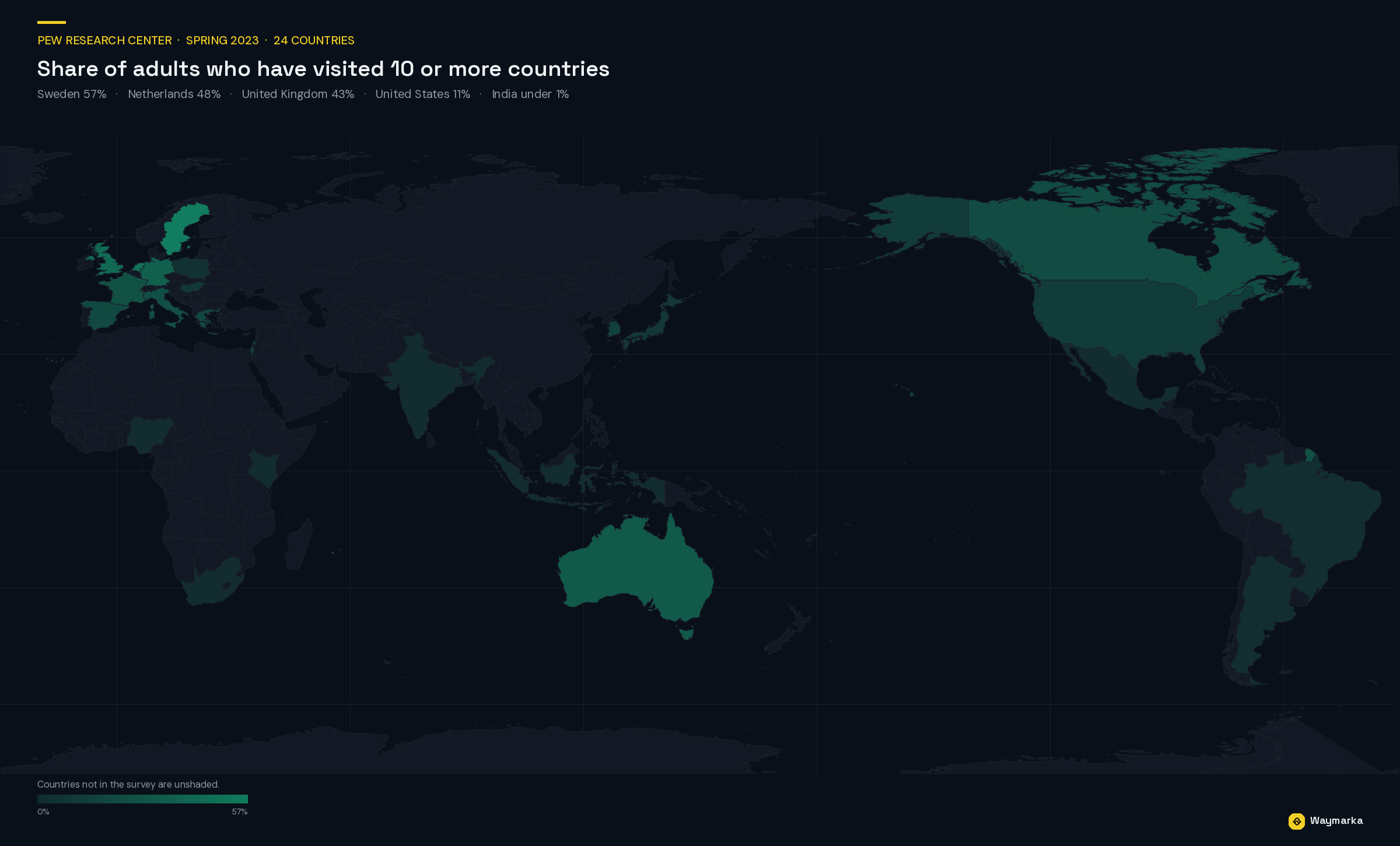
- Sweden: 57 percent have been to 10 or more countries. Almost nobody in the sample had never left Sweden.
- Netherlands: 48 percent have been to 10 or more.
- United Kingdom: 43 percent have been to 10 or more; 4 percent have never left.
- Germany: 36 percent have been to 10 or more.
- Australia: 32 percent have been to 10 or more; 10 percent have never left.
- United States: only 11 percent have been to 10 or more, even though roughly three-quarters have been to at least one other country. Twenty-three percent have never left the US. The US survey interviewed 3,576 adults between 20 and 26 March 2023. France sits at 26 percent, Canada at 22 percent.
- Japan: 8 percent have been to 10 or more; 34 percent have never left Japan.
- India: 95 percent have never left the country; 3 percent have been to one other country. The share who have been to 10 or more rounds to zero.
Pew’s own explanation is geographic as much as economic. European countries are smaller, close together, and, inside the EU, easy to move between. The United States is large, rich, and still produces a travel pattern in which many international trips are to Mexico or Canada and not much further. Higher-income respondents, in most countries Pew surveyed, were more likely to have traveled — and, in the high-income countries, more likely to have reached 10 or more.
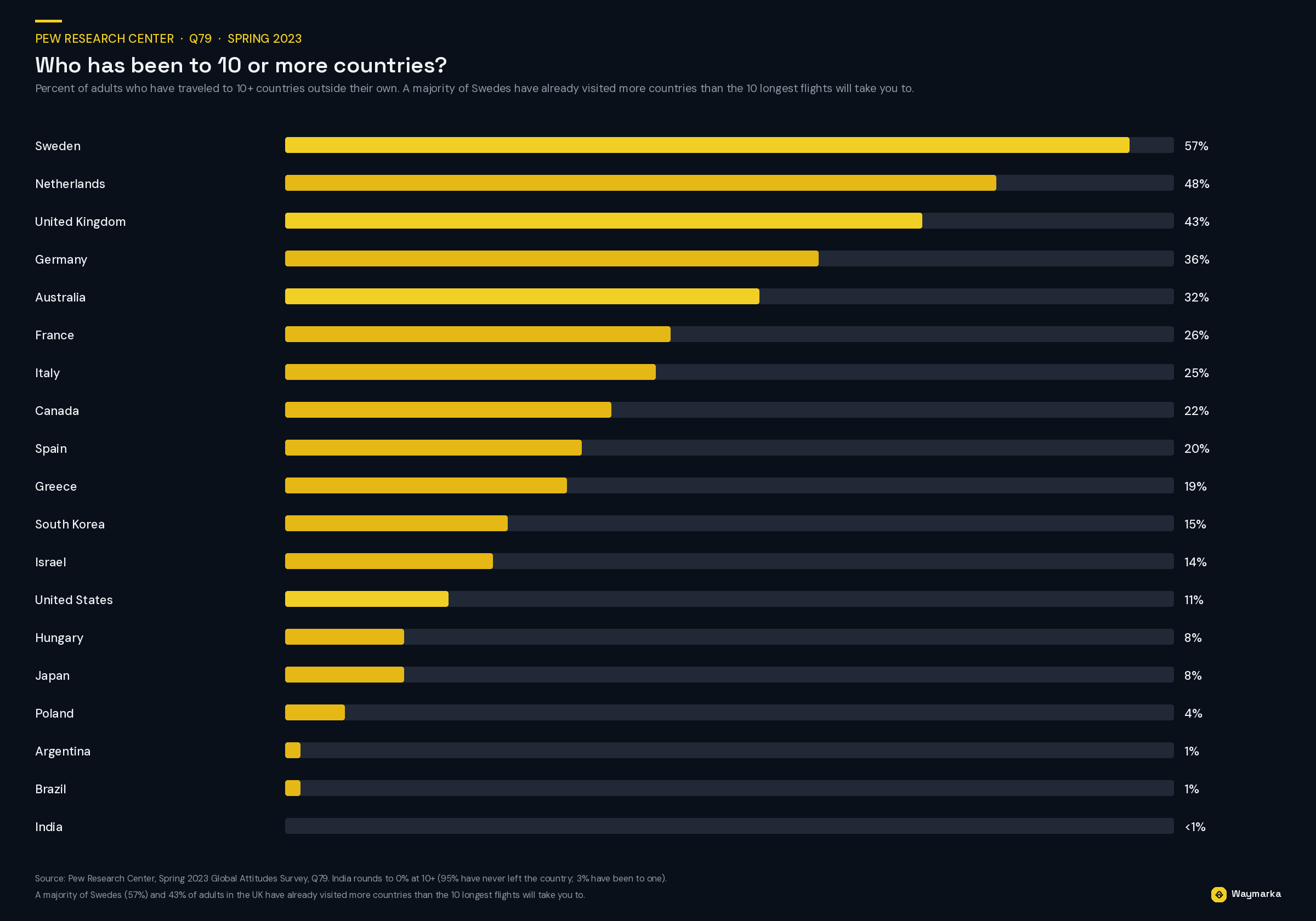
None of these figures is a frequent-flyer average. Pew asked a cross-section of adults, not members of a mileage programme. But they do give you the right scale. If 57 percent of Swedes and 43 percent of adults in the UK have already visited 10 or more countries, then “10 countries” is not an elite avgeek badge in every part of the world. In the United States, it is.
Why a high-mileage year can still be a small map
This is the part frequent flyers already know in their bones and rarely put a number on.
A consultant who flies London–New York 20 times a year can clear a long-haul mileage threshold and still have a two-country year. A cabin-crew roster built around a single hub pair can look the same. A short-haul European flyer, by contrast, can add five countries in a month without ever sitting down for more than three hours. The routes that break distance records are, almost by definition, thin connections between a small set of well-served hubs. You can ride the entire current frontier of commercial range and still not match the lifetime country count of a typical adult in Stockholm.
Layover rules make the gap wider, or narrower, depending on how you count. A tight connection in Singapore, Doha or Dubai does not feel like a visit to anyone who has done it, but it will inflate a country total if you count every passport stamp. A more honest definition is the one most avgeeks already use among themselves: you have visited a country if you left the airport, or at least entered it with the intent to stay.
So what should you actually compare?
If you want a benchmark, use Pew’s brackets rather than a made-up global average:
- Never left your own country.
- 1 to 4 other countries.
- 5 to 9.
- 10 or more — which, in Pew’s 24-country set, is a median of 13 percent of adults, a majority in Sweden, and only 11 percent in the United States.
Then look at your own flights, not your mileage balance. The useful question is not “how many miles am I from a million?” It is “which countries have I actually set foot in, and which of these long sectors would add a new one?”
On the 2027 frontier, very few of them will.
Sources and notes
Verified
- Unique comparison computed for this piece: the 10 longest passenger flights bookable in 2027 (see the companion draft, “The 10 longest flights you can book in 2027”) touch nine countries and total 149,509 km in great-circle distance, or 149,509 / 40,075 ≈ 3.73 times the equatorial circumference.
- Pew Research Center, “How experience with international travel varies across 24 countries”, 6 December 2023, and the official topline for Q79. Figures cited above are taken from the topline and the published report. US sample: 3,576 adults, 20–26 March 2023, American Trends Panel Wave 124, margin of error ±2.0 percentage points.
- Gössling, S. and Humpe, A. (2020), “The global scale, distribution and growth of aviation: Implications for climate change”, Global Environmental Change 65:102194. Also summarised by Lund University: about 11 percent of the world flew in 2018; at most 4 percent flew internationally; 1 percent of the population accounted for more than half of passenger aviation CO₂.
Not used as a frequent-flyer average, and why
- SAS EuroBonus “million miler” challenge statistics, reported by Live and Let’s Fly in February 2025, put the average participant at 17 countries and four continents. That cohort is a promotional mileage-run sample (78 percent enrolled after the campaign started; 77 percent were Basic status). It is interesting, but it is not a picture of ordinary frequent flyers, and it is not used as a benchmark here.
- Older commercial surveys (for example a mid-2010s Hostelworld report often quoted as “Americans have visited three countries, Britons 10”) are more than a decade old and are not used here.
Unverified
- No public dataset gives a robust average country count for airline frequent-flyer programme members as a class. Any single number marketed as “the average frequent flyer has visited X countries” should be treated as unverified unless the sample and definition are published.
Frequently asked questions
How many countries has the average person visited?
There is no reliable global average. Across 24 countries in Pew’s 2023 survey, a median of 79 percent of adults had been to at least one other country, and a median of 13 percent had been to 10 or more. In some of the middle-income countries Pew surveyed, a majority had never left home.
How many countries have Americans visited?
In the same Pew survey, about three-quarters of US adults had been to at least one other country, but only 11 percent had been to 10 or more. Twenty-three percent had never left the United States.
Does flying more miles mean you have visited more countries?
Not reliably. A transatlantic commuter can accumulate miles on two countries for years. The 10 longest bookable flights in 2027 cover 149,509 km and still touch only nine countries.
What should count as visiting a country?
There is no official rule. A practical one is: you visited if you entered the country to stay, not just to change planes. Pick a definition and use it consistently, including for your home country.
Is 10 countries a lot?
It depends where you live. It describes a majority of adults in Sweden, 43 percent in the UK, 32 percent in Australia, and 11 percent in the United States, according to Pew in 2023.
See your real country count
Guessing from memory almost always produces the wrong number — usually a little high, occasionally a surprise low once the layovers are stripped out. The clean way to do it is to start from the flights themselves, plot them on a pin map, and let the countries light up from the routes you have actually taken. Waymarka is a flight travel log built around that black map, with pins, country presence and shareable views. You can start one free at waymarka.app/auth.
Pew Research Center, Qantas, Singapore Airlines and other airline names are trademarks of their owners. Waymarka is not affiliated with them.